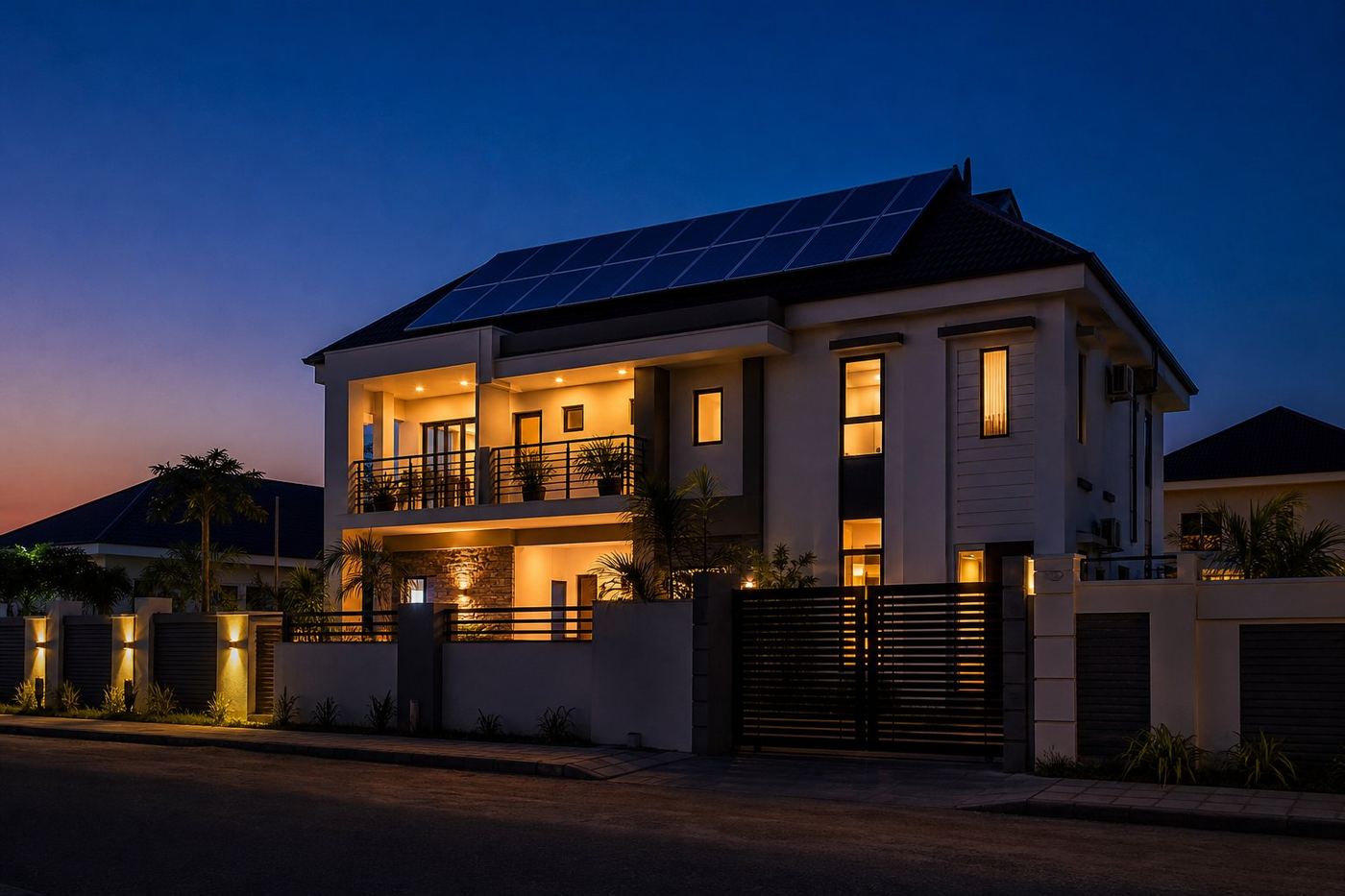
Residential
Whole-home solar, storage and changeover, designed from your measured load — never from a template. Every house drinks differently.
Size your home →/// ABUJA HQ — INSTALLS NATIONWIDE — OPEN 24 HOURS
Okeh Tech does not merely sell solar hardware. It helps you understand, size and transition to dependable power — then installs it, monitors it and stands behind it nationwide.
ResidentialCommercialIndustrialWater pumpsStorageMaintenance
One locked reference example, and one scenario you control. Both are modelled — neither is a quote. The survey makes it real.
Locked reference scenario — inputs and outputs are fixed. Savings and payback are estimates, not guaranteed returns. ₦0 solar fuel spend does not eliminate residual grid charges, servicing, replacement or ownership costs.
Fuel spend and the grid bill are tracked separately so nothing is double-counted. Change any input — the locked reference plate stays untouched.
/// TYPICAL PAYBACK: 3–5 YEARS — then 20+ years of essentially fuel-free power.
The company's published figures. The published range above is the company's general experience. The 2.9-year figure beside it is this page's locked illustrative reference scenario — a different assumption set, kept visibly separate.
Build your daily electricity demand from the appliances you actually use.
The demo preset is a transparent three-bedroom, two-AC schedule built to land near the referenced configuration: 10 × 650W panels + approximately 15kWh storage + 10–12kW inverter class. Its arithmetic is shown openly below — including any discrepancy.
Fridges and freezers cycle — the compressor is not drawing full power 24 hours a day. The duty % control sets the effective runtime assumption (35% of 24h = 8.4h for the fridge above).
Abuja's daylight, read as an energy budget — not a weather report.
Even the worst month outshines half the world.
Peak sun hours are not daylight hours. A peak sun hour compresses a whole day of variable sunlight into the equivalent number of hours at full 1,000W/m² intensity. Abuja sees roughly 11–12 hours of visible daylight, but morning haze, cloud and low sun angles deliver less than full power for much of it. 5.5 is the energy-budget number that sizes an array. These are supplied editorial reference figures — not freshly measured or live meteorological readings.
The 2am chorus, retired.
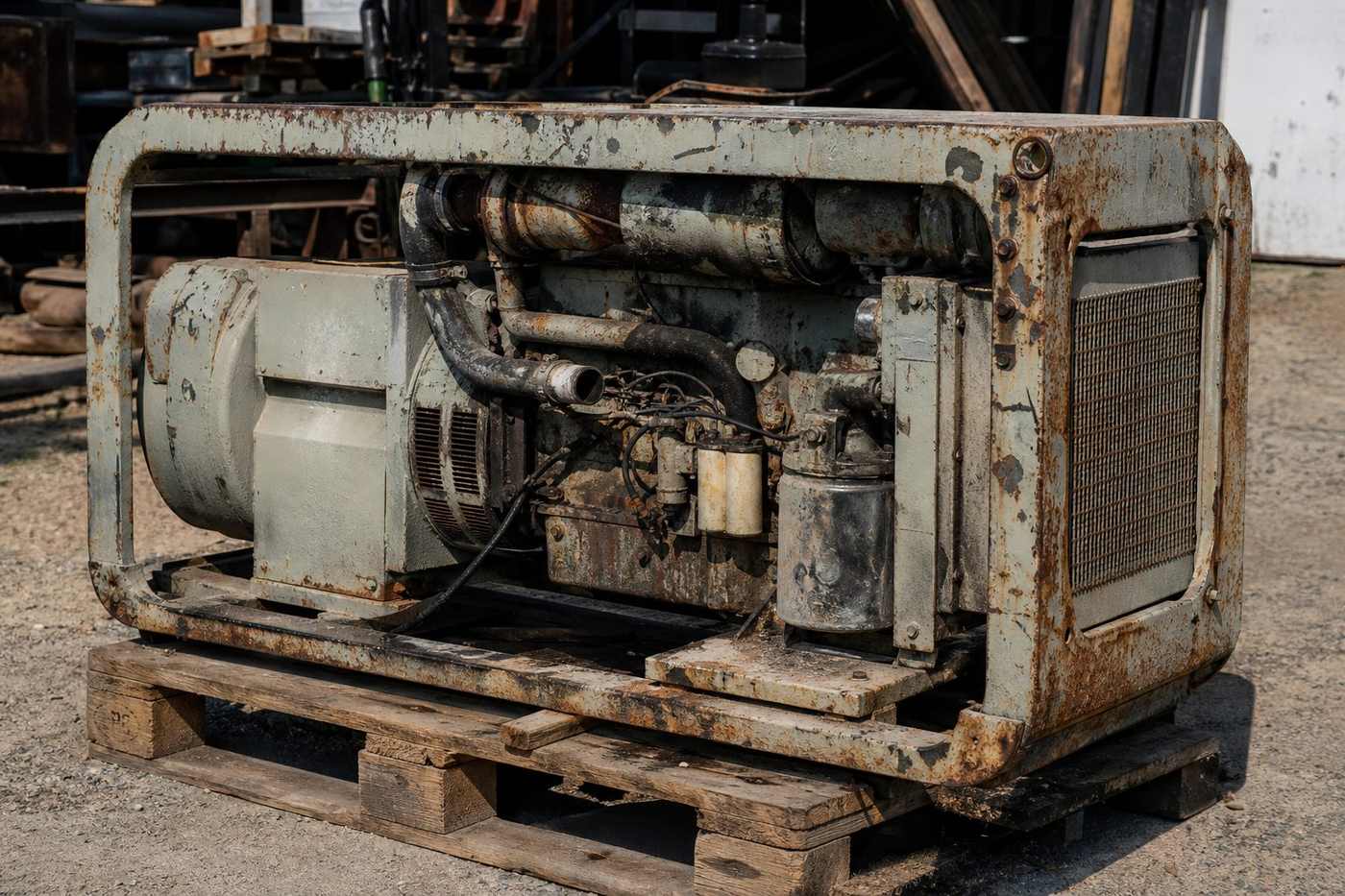
Generator readings are illustrative references and vary with equipment, load, enclosure and measurement conditions; no universal measurement standard is being claimed here. Decibels are logarithmic — a bar twice as long is not twice as loud. The rooftop row is deliberately empty: it is the absence of an engine, not a verified 0 dB(A) acoustic measurement of the whole house.
Six doors in. One standard of work behind all of them.
Whole-home solar, storage and changeover, designed from your measured load — never from a template. Every house drinks differently.
Size your home →Shops, offices, clinics and cold rooms kept trading through outages — three-phase systems sized against real business load, not optimism.
Request survey →Higher-demand facilities where downtime carries a price: hybrid plants, substantial storage and properly engineered protection gear.
Request survey →Off-grid pumping for farms and ranches. Sun in, water out — no diesel pump, no fuel runs, no waiting on the tanker.
Request survey →Lithium banks retrofitted to existing inverter setups or built into new rigs — for nights, bad-grid seasons and everything the grid plans to do next.
See the stack →Annual servicing, remote monitoring and rapid on-site response. A solar system is a machine; this is the team that keeps it running.
Book servicing →
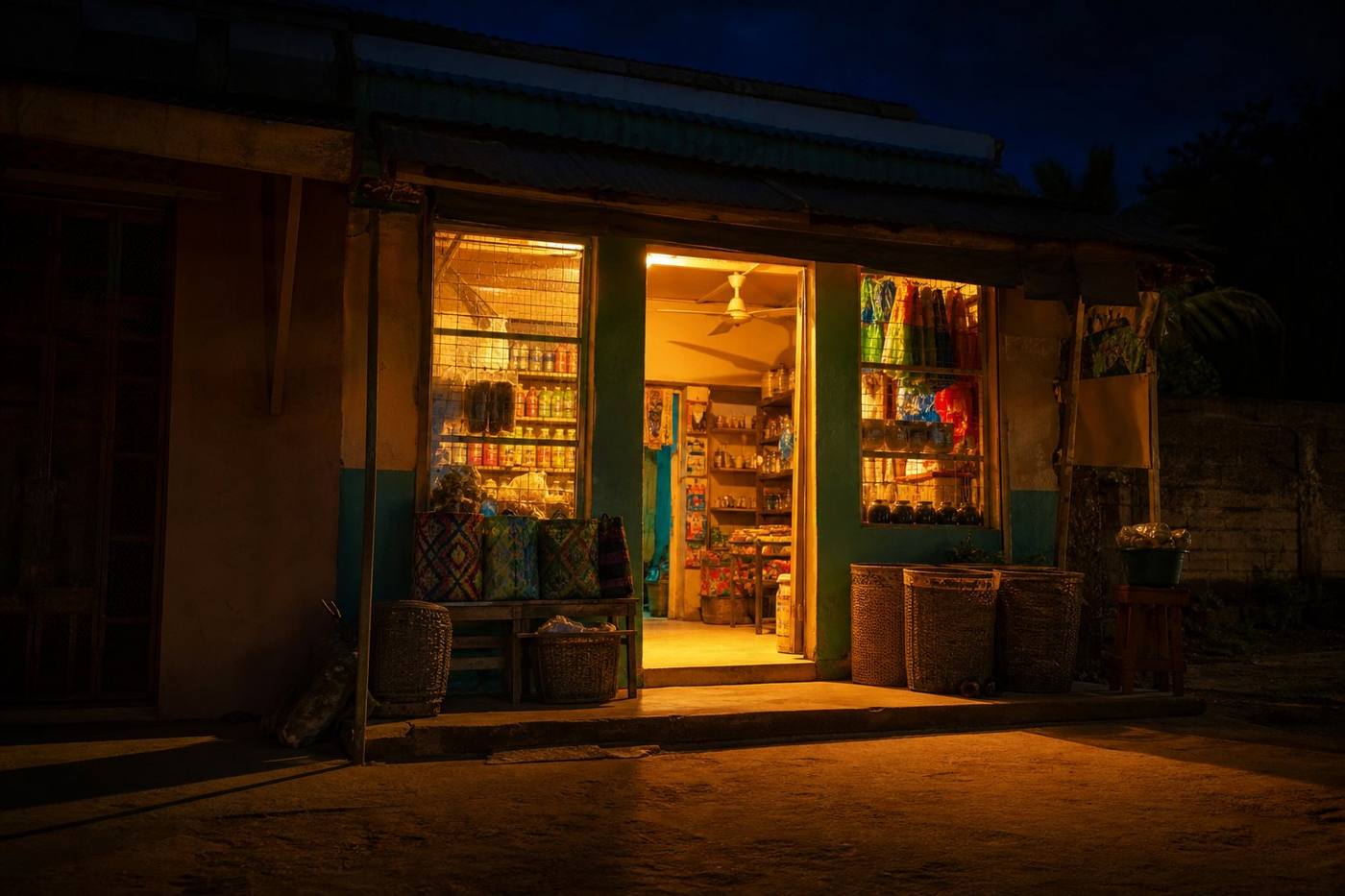
The reference rig, component by component — each with a role, a number and a warranty.
11kW
Inverter
The brain. Converts the array's DC into clean household AC and manages grid, generator and battery sources without asking you to think about it.
15kWh
Storage
The reserve. A lithium bank that carries the house through the night and the worst grid hours without a generator touching it.
10 × 650W
Array
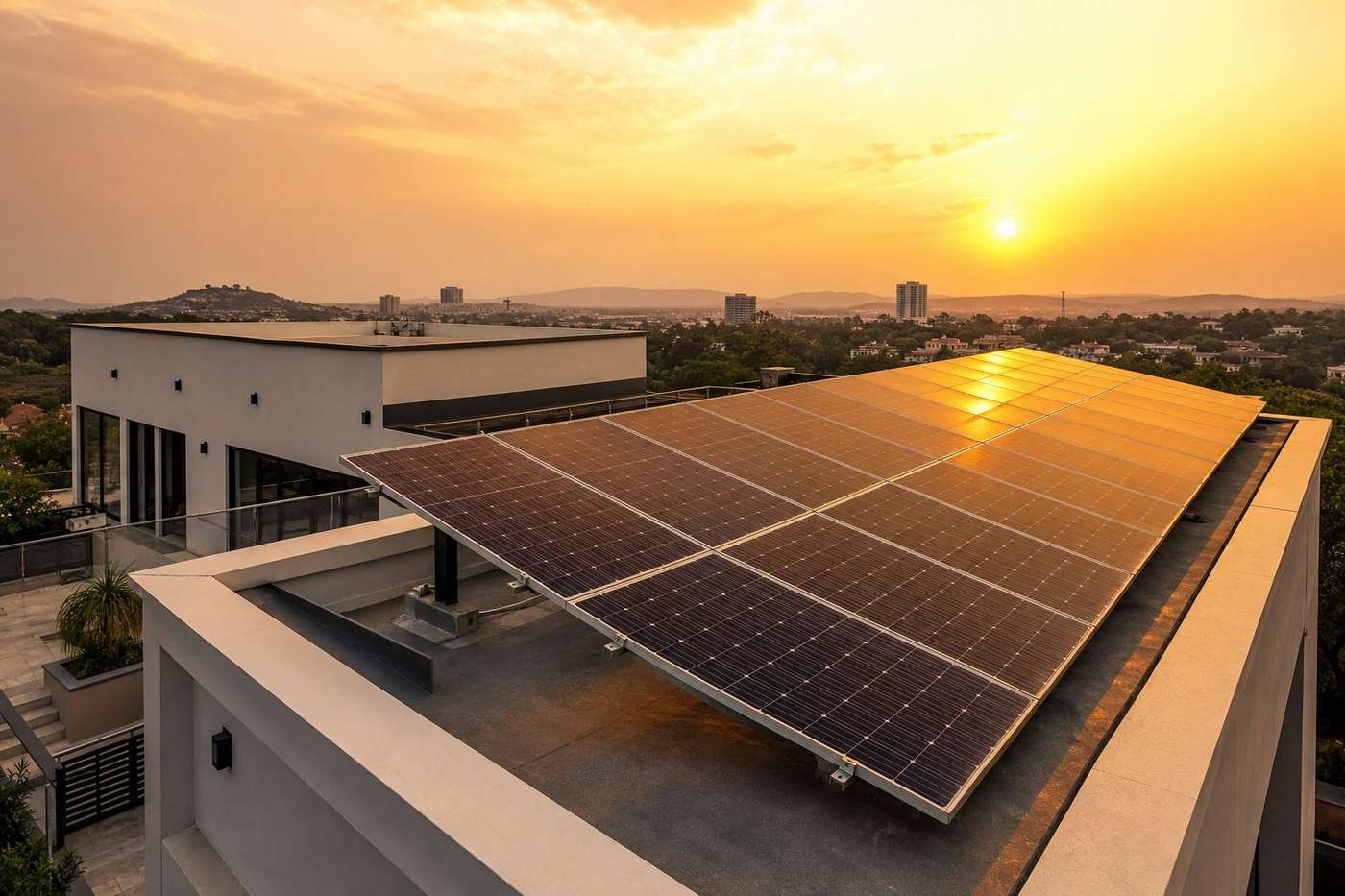
The harvest. 6.50kWp of Tier-1 monocrystalline collection area on your roof, doing the sun's shift every day.
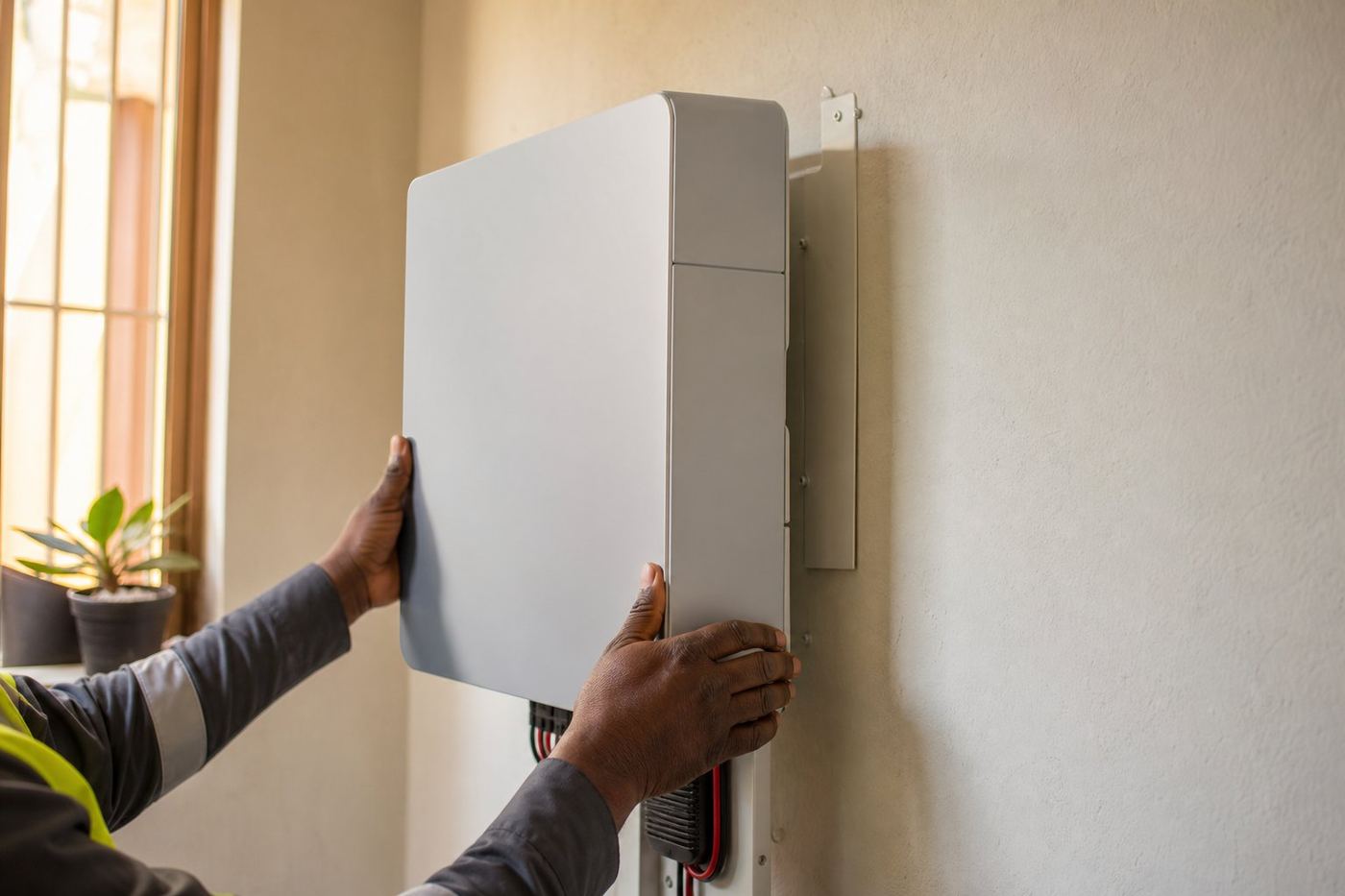
/// The warranty stack — component labels as published
24/7 monitoring — remote diagnostics, mobile app and alerts.
4.9 / 5 1 review
Company-published rating, carried over from earlier builds. This preview does not independently verify it, and no individual review quotes are reproduced here.
Real installation documentation, not abstract promises.
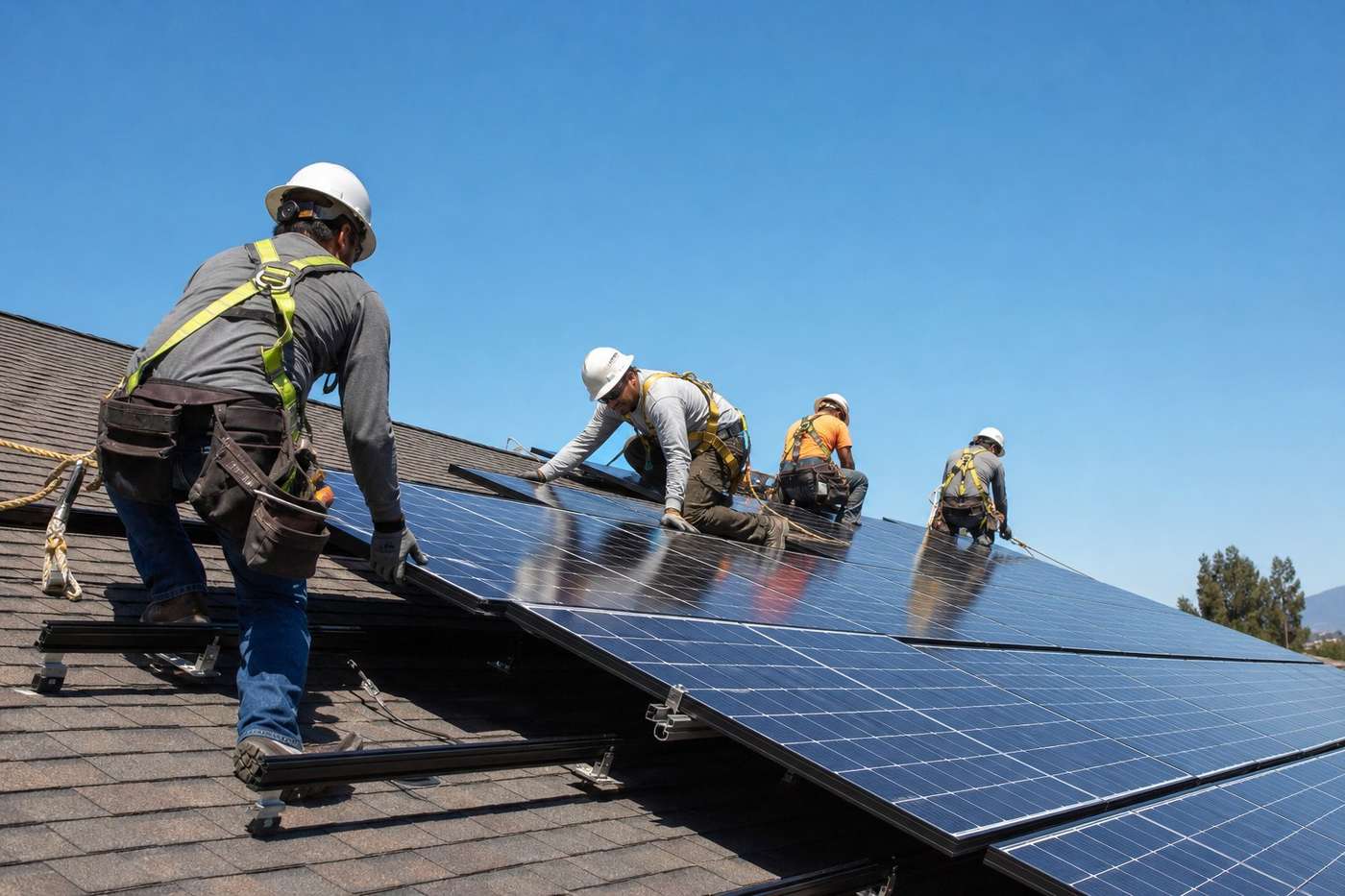
No stock photograph will ever be passed off as a specific Okeh Tech installation. Each entry above keeps its exact documentation caption; where the genuine project image is not yet available, a typographic field plate stands in — honestly labelled.
The instruments below all read from the same Home Energy Passport you built in the Load List. Nothing is entered twice; change one input and the dependent dials move.
How long must your home stay alive after sunset? The essential group is deliberately smaller than the whole house — not every appliance has to stay on during an outage. ACs are excluded by default for a reason.
Essential loads — what survives an outage
Trim the essential group (drop the freezer, halve the fans), shorten the window, lower the reserve — or specify a custom bank. All legitimate survey outcomes.
What happens when everything switches on? Peak group — from your Load List "Peak" ticks.
/// WHY kW AND kWh ARE DIFFERENT ANIMALS
kW is the rate — how hard power is flowing right now (the inverter's problem). kWh is the volume — how much flowed over time (the battery's problem). A 1,100W AC running 5 hours drinks 5.5kWh. Sizing the inverter on daily kWh, or the battery on peak kW, is how undersized systems get sold.
Can the proposed array physically fit?
Footprint defaults to a 650W module (~2.38 × 1.13m ≈ 2.7m²); the ×1.35 allowance covers walkways, setbacks and fixing clearance. Both are editable. A homeowner's typed dimensions can never prove structural capacity — that is a surveyor's inspection. Structure, fixing method and final layout are confirmed at survey.
Will the system still make sense in August?
In the weak-month scenario the array produces 21.8kWh — 94% of this schedule's demand. That is what "conservative" buys: August becomes a rounding error, not a blackout. Battery and occasional grid imports cover the gap.
What is generator dependence costing you?
Cost composition — now
Generator hours are context only — fuel and servicing already carry the cost. The grid bill and generator spend are kept as separate lines so nothing is double-counted, and solar does not assume your grid bill falls to zero: the residual stays on the books. At 85% solar contribution the generator moves from daily driver to rare reserve — fuel spend collapses, servicing nearly disappears, and the grid bill shrinks to its residual.
What changes if I pay upfront versus over time? Monthly saving is read from your personalised meter above. The staged arrangement is an illustration — 50% deposit, balance over six months, premium editable. This page never invents a bank's interest rate: financing costs and approval belong to the lender.
The locked ₦80,000 reference meter stays untouched above; this studio only rearranges how the same system gets paid for.
| Scenario | Total modelled cost | Financing charges | Payback |
|---|---|---|---|
| Cash purchase | ₦2.4M | — | ≈2.9 yrs |
| Staged (illustrative) | ₦2.6M | +₦192,000 | ≈3.2 yrs |
| Bank financing — 6–36 months via partner banks | Rates, fees and approval are not published here and are never modelled without supplied terms. Request them with your survey. | ||
What changes between a smaller and larger rig?
| Measure | Config A — lean (proposed − 2 panels) | Config B — proposed (from your passport) |
|---|
What should be ready before the surveyor arrives?
0 / 9
Nothing ticked yet — work down the list. Every tick shortens the survey visit. This is a planning aid, not a substitute for electrical inspection. Missing items do not block a survey — they just get added to the surveyor's list. No account, no contact details: the checklist lives in your browser only.
Optional, unhurried and never gated — every instrument above also works alone. Enter or leave the sequence at any step; nothing you have entered is ever erased by moving on.
One page that carries everything you modelled — appliances, demand, proposed rig, backup window, money context and the questions the survey must still answer.
OKEH TECH — HOME ENERGY PASSPORT (PRELIMINARY)
Session plan · illustrative modelling · not a final design
0 / 9 prepared — see the readiness check
Concept preview — this passport is a preliminary planning summary built from modelling defaults and your selections. It is not an engineering design, a quote or a performance guarantee. Sizing, pricing and suitability are confirmed only by the on-site survey. It is generated on this device; no household information is transmitted anywhere.
Print produces a clean one-page summary using the browser's own PDF writer — an honest document, not a renamed web page. Copy builds a short text brief you can paste into any message channel. Your plan is saved in this browser only (localStorage) so the instruments remember you between visits on this device. Nothing is sent to any server.
Residential: 1–2 days. Commercial: 1–3 weeks.
25/10/10-year component warranty stack — panels 25 years, inverter 10 years, battery 10 years — plus 2 years workmanship.
6–36 months through partner banks.
Yes, subject to correct system design and sizing.
Yes, nationwide.
Company-published answers, reproduced without added terms, approval guarantees, eligibility conditions or financing rates.
/// 12 — THE NEXT STEP
Bring the passport. The surveyor verifies the roof, the surges, the board and the shade — and replaces every "modelled" on this page with a number that is yours.